

We have created an information hub to support our Orange Genie Accountancy clients, our Umbrella Employees and agencies where the the Covid-19 rules and legislation are explained for recruiters, contractors and the self-employed. Click here to find out more>>

If you're facing financial hardship now or in the near future due to the COVID- 19 crisis, you will be keen to understand what help the Government are offering to contractors, the self-employed and small businesses. On Friday 20th March the Chancellor, Rishi Sunak, announced a number of measures designed to support businesses and individuals through these difficult times and further detail was issued on 15th April 2020.
We now know which of the measures announced by the Government directly help the UK’s contractors operating through their own Limited companies (PSC’S) or the self-employed. There is still an increasing amount of pressure building on the Government to put forward further measures to help this sector of the economy, especially PSC contractors whose support is based only on the salary element of their take home pay and excludes dividend income.
We will have to see if further help is forthcoming but in the meantime this is what we do know.
The scheme provides support to all UK businesses and the Government have confirmed that this also covers single director/shareholder companies or PSC’s.
Employers will be able to access support to continue paying part of their employees’ salary for those employees that would otherwise have been laid off during the crisis.
The affected employees will need to be designated as “furloughed workers” and notified of the change. Claims for the grant will be made through HMRC’s new online portal.
For the months of March to July 2020, HMRC will reimburse 80% of the furloughed workers wages costs, up to a maximum of £2,500 per month. Employers can choose to top up these payments to full pay. The job retention scheme is based on your “usual wage” and will not include commissions or bonuses. For PSC contactors, dividends are excluded. The grant also covers the associated Employers NIC and pensions costs. From August 2020 onwards, employers are expected to fund the Employers NIC and pension costs. The Governments contribution to gross salary costs will also reduce from 80% to 70% in September and 60% in October.
The scheme will close completely on 31 October 2020.
If you have employees on your books this next measure may help you. Where an employee is unable to work either because they are sick or they have been advised to self-isolate as a member of their household is sick, they will be entitled to Statutory Sick Pay (SSP).
To be eligible for sick pay the employee must:
The usual requirements to provide proof of illness are relaxed in these circumstances and SSP will begin from day 1 of the sickness period and not the usual day 4.
SSP is not paid if the employee is already receiving Statutory Maternity Pay or Allowance.
Legislation is to be introduced to allow small-and medium-sized businesses and employers to reclaim Statutory Sick Pay (SSP) paid for sickness absence due to COVID-19. The scheme will work as follows:
A rebate scheme is being developed. Further details will be provided in due course once the legalisation has passed.
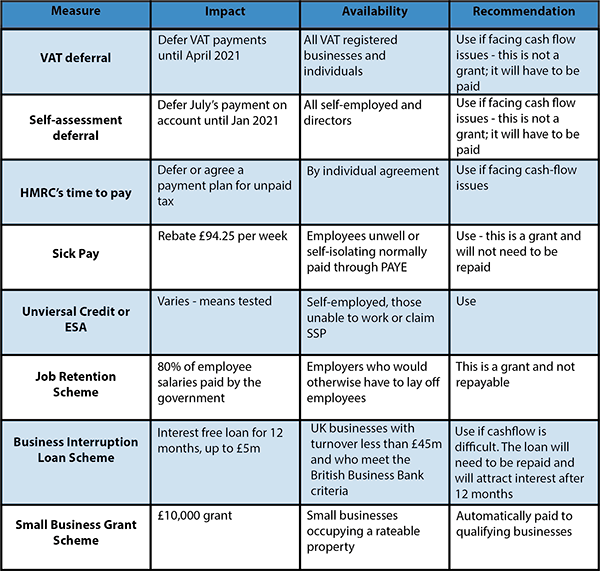
During the week commencing 23 March 2020, a new temporary Coronavirus Business Interruption Loan Scheme, delivered by the British Business Bank, will launch. This is designed to primarily support small and medium-sized businesses to access bank lending and overdrafts. The maximum value of a facility provided under the scheme will be £5 million.
Businesses can access the first 12 months of the finance interest free, as government will cover the first 12 months of interest payments. The government will also provide lenders with a guarantee of 80% on each loan (subject to a per-lender cap on claims) to give lenders further confidence in continuing to provide finance to small businesses. The government will not charge businesses or banks for this guarantee, and the Scheme will support loans of up to £5 million in value.
To be eligible for the scheme your business must be UK based, with turnover of no more than £45million per year and meet the other British Business Bank eligibility criteria. The full rules of the Scheme and the list of accredited lenders is available on the British Business Bank website. All the major banks will offer the Scheme once it has launched. There are 40 accredited providers in all.
You should talk to your bank or finance provider (not the British Business Bank) as soon as possible and discuss your business plan with them. It is vital that you have an up to date Profit and Loss as well as Cashflow statement to share with the provider. This will help your finance provider to act quickly once the Scheme has launched. If you have an existing loan with monthly repayments you may want to ask for a repayment holiday to help with cash flow.
The government will provide additional Small Business Grant Scheme funding to support small businesses that already pay little or no business rates because of small business rate relief (SBBR), rural rate relief (RRR) and tapered relief. This will provide a one-off grant of £10,000 to eligible businesses to help meet their ongoing business costs.
To be eligible the business must be based in England and occupy property. Your local authority will write to you of you are eligible for the grant and you need not make an application.
All VAT payments will now be deferred for 3 months. The deferral applies with immediate effect from 20 March 2020 until 30 June 2020. All VAT registered businesses are eligible for this relief automatically. There is no application process, you are not obliged to make any VAT payments during this period. VAT returns will still need to be submitted. Any VAT liabilities accumulated will need to be paid before April 2021. If you pay your VAT by Direct Debit you may want to cancel this.
If you normally are due a VAT refund you should claim as normal. VAT refunds will still be processed in this period.
Self-assessment or Income Tax payments due in July 2020 will be deferred to January 2021. Again, this is an automatic relief and no application is required. Taxpayers will be given until 5 April 2021 to pay any liabilities that have accumulated during the deferral period. No penalties or interest for late payment will be charged in the deferral period.
HMRC have also scaled up their Time to Pay offer to all firms and individuals who are in temporary financial distress as a result of Covid-19 and have outstanding tax liabilities. If you have missed a corporation tax payment or might miss your next payment due to Covid-19, you can call HMRC’s dedicated helpline: 0800 0159 559. The helpline is open Monday to Friday 8am to 8pm and Saturday 8am to 4pm.
This scheme offers support to the self-employed who have a profit of less than £50,000 in 2018-19 or an average trading profit of less than £50,000 in the three tax years to 2018-19. At least half your profits have to come from self-employment and you need to have filed your 2019 tax return. If you haven’t filed it yet, you have until the 23rd April to do so.
The first grant payment under the scheme will pay a cash grant worth 80% of your average monthly trading profit over the last three years and will payable around June. The maximum amount available is £7,500. The amount paid will cover lost income for March, April and May. You can continue to work and claim this grant. The scheme is designed to guarantee a minimum level of income so you can use it to top up if work is reduced.
A second grant has been announced for a further three month period that will be available from August 2020. The second grant will be worth 70% of your average monthly trading profits for a three month period up to a maximum of £6,570.
HMRC should have sent you an invite to make a claim if they believe you are eligible. Claims can be made here. We understand that applications for the second grant will open in August 2020. Once accepted the cash will be paid directly into your bank account, usually within 6-10 days.
Unfortunately, this scheme will not cover everyone. If your profits are in excess of £50,000 or you began to trade in the tax year 19-20 you will not qualify. If you find yourself unable to access the scheme or with cash flow issues before June you may still be able to access other available government support including more generous universal credit and business continuity loans. You can also defer tax payments including VAT and the July self-assessment tax payment.
Being self – employed you are not eligible for SSP but if you are unable to work because you are suffering from COVID-19 or are advised to self-isolate, you can now more easily make a claim for Universal Credit (UC) or new style Employment and Support Allowance (ESA).
You may be able to get Universal Credit if:
If you are already claiming UC, and are required to stay at home or are ill as a result of coronavirus, the Minimum Income Floor (an assumed level of income) will not be applied for a period of time whilst you are affected. This change will apply to all Universal Credit claimants and will last for the duration of the outbreak. New claimants will not need to attend the jobcentre to demonstrate gainful self-employment.
You can apply for Universal credit here
The new style Employment and Support Allowance (ESA) may also be available. New Style’ ESA is a fortnightly payment that can be claimed on its own or at the same time as UC. You may be able to get ESA if you’ve paid and/or been credited with enough National Insurance contributions in the 2 full tax years before the year you’re claiming in.
Your (or your partner’s) savings will not affect how much ‘New Style’ ESA you’re paid. If your partner works, it does not affect your claim. Most income is not taken into account (but a personal pension can affect the amount you may receive).
If you are eligible for new style ESA, it will now be payable from day 1 of sickness, rather than day 8, if you have COVID-19 or are advised to self-isolate.
You can find out more about the new ESA here. The application form is also available through this link.
For further help with UC or ESA claims you can contact the Universal Credit Helpline on 0800 328 5644. They are open Monday to Friday 8am to 6pm.
As for small businesses all VAT payments will now be deferred for 3 months. The deferral period and rules are the same as set out above. Self -assessment July payments on account will be deferred until January 2021 and HMRC will consider Time to Pay arrangements.
During this difficult time, cashflow will be critical. Now is the time to make sure you are completely in control of your finances both business and personal.
Ensure that you have invoiced for all outstanding work and talk to your customers to ensure you will be paid on time
Review regular expenditure. Is there any that can be cancelled in the short term to assist with cashflow?
If you don’t have one, create a simple budget. Consider the minimum income you need to cover your bills. Remember there may be some cost savings during this time, for instance travel and eating out costs are likely to fall considerably. Do you have income and or savings that will cover this?
Do you have Key Man or Income Protection policy? Now would be a good time to check the terms and see if the policy will pay an income to your business, or you.
Whether you are a home owner or a renter you may be concerned about meeting your monthly payments. The government has agreed with mortgage lenders that they will offer repayment holidays of 3 months to households in financial difficulty due to COVID-19. This mortgage holiday is also extended to buy to let mortgages to assist landlords whose tenants may be experiencing financial difficulties. Payment holidays will be offered to customers who are up to date with payments and are not already in arrears.
If you are concerned about your current financial situation you should contact your lender at the earliest possible opportunity to discuss if mortgage holiday is available to you.
If you are a tenant experiencing financial difficulties the government have promised to ensure you will not face the threat of eviction for at least 3 months. Landlords and tenants are expected to work together to establish an affordable repayment plan, taking into account your individual circumstances.
If you are concerned about repaying personal loans or credit card bills as a result of COVID-19 you should talk to your lender straight away. The Financial Conduct Authority (FCA), have called on lenders to use flexibility in their rules to support customers, depending on individual circumstances. If you can agree a payment holiday with them, they should be recording these in such a way that it will not impact your credit score.
These packages of financial support have been announced quickly by the Government. We expect more detail to be announced over the coming days and weeks as well as further measures in response to a rapidly changing situation. We will look to provide an update and detail as it becomes available.
If you have any questions or if we can help in any way, please call our expert team on 01296 468 483 or email info@orangegenie.com